Visit ActiLingua
Page 1: The German Language and Its Many Forms
Where do they speak German?
With more than 120 million German speakers in 8 countries around the world, it is hardly surprising that the actual usage of the German language varies. Like English, German is a pluricentric language with three main areas of usage: Austria, Germany and Switzerland.
Switzerland is a case of its own, with its local dialects of the vernacular 'Switzertütsch' (Swiss German) remaining mostly unintelligible even to
Germans and Austrians. The relation between the vernacular 'Switzertütsch'
and standard German is one of diglossia.
For this reason, the following abstract does not include German as used in Switzerland.
Benrath line and 'Weißwurst' equator
If judged on linguistic features rather than by national affiliation, there are two major regions of German usage: Middle German and Low German.
These two forms are separated by an isogloss called the Benrath line
(marked red on the map below).
What is standard German?
Historically and linguistically, standard German is a mixture of Middle German and High German (i.e. most Austrian dialects). It did not develop out of one regional dialect but was artificially created by poets, philosophers and scholars.
At all our of recommended language schools, you will be taught standard German. Acquiring some local slang and local dialect style vocabulary is fun and adds excitement to your German learning experience. However, your main German learning activities will be centred on standard German.
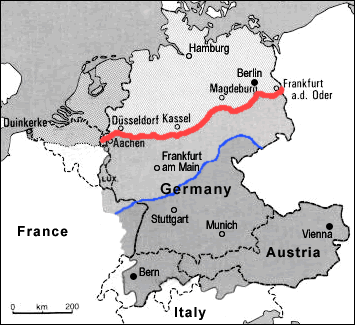
Map of German language usage:
German in Germany, Austria and Switzerland.
The red line (Benrath-Linie) divides Low German and Middle German. The blue line (Main-Linie) divides Middle German and High German.
Deutsch-lernen.com recommends:
Learn melodious standard German at ActiLingua Academy in Vienna.
 Order Free Brochure
German is also spoken in the following cities:
Bamberg | Berlin | Cologne | Dresden | Frankfurt am Main | Freiburg im Breisgau | Graz | Hamburg | Heidelberg | Innsbruck | Kitzbühel | Klagenfurt | Leipzig | Linz | Munich | Münster | Regensburg | Salzburg | Stuttgart | Vienna